
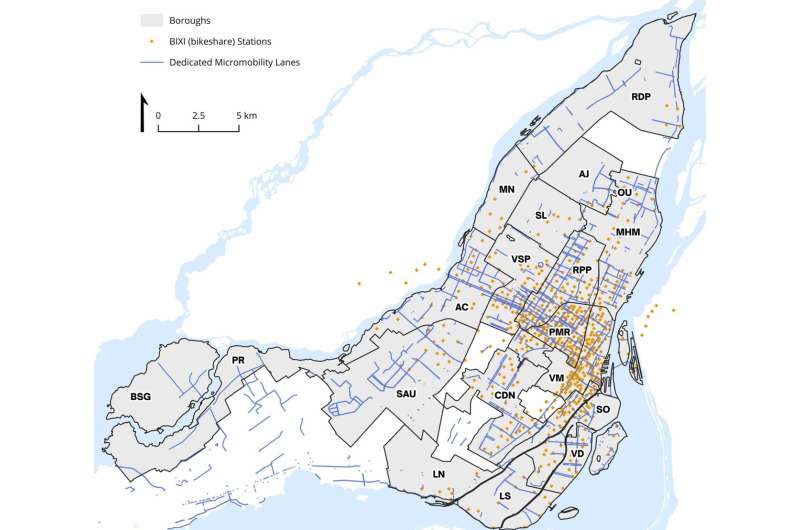
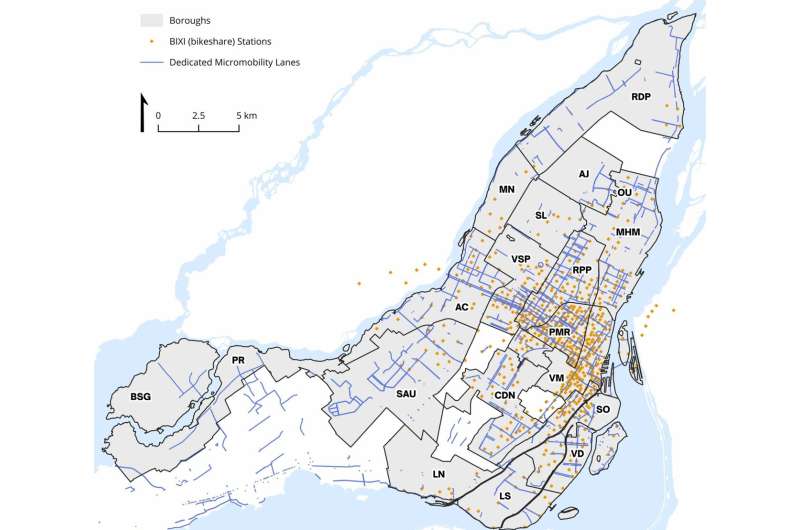
Bike lanes, BIXI stations and other micromobility infrastructure make up just 2% of Montreal’s street space—even in neighborhoods where cycling demand would justify more—according to a new study by McGill University researchers. They think that the measure they developed to arrive at their findings can also help assess the situation in other cities.
“This is best used as a diagnostic tool for where there’s too little space,” said Daniel Romm, a Ph.D. candidate in McGill’s Department of Geography and lead author of the study. “It’s very intuitive: square meters per traveler is a simple way to understand whether infrastructure is keeping up with demand.”
While city planners may know how many kilometers of bike lanes exist, this study calculated how much area is dedicated to micromobility relative to the full road network and compare that with how people actually travel. The team combined high-resolution street geometry data from the City of Montreal with regional travel surveys.
The results reveal a clear imbalance: cars occupy nearly 98% of road space, even though they account for only about 95% of trips. Micromobility—including bicycles, e-bikes, and scooters—makes up the remaining 5% of trips, but only 2% of the space.
In boroughs like Plateau-Mont-Royal and Rosemont–La Petite-Patrie, where micromobility is especially popular, the mismatch is even more pronounced. According to the study, in Plateau-Mont-Royal, of trips made by either cars or micromobility, 22% use micromobility, but micromobility infrastructure still takes up less than 5% of the street space.
The researchers looked specifically at dedicated micromobility infrastructure—physically separated bike paths, cycle tracks, and BIXI docks.
“We found that micromobility infrastructure takes up a very small proportion of street space in Montreal,” said Romm. “Even doubling all existing infrastructure, it still makes up just a minuscule proportion.”
That’s exactly what the researchers set out to test. They modeled various future scenarios, including one where all micromobility infrastructure was doubled. The result? Significant gains for cyclists, without dramatically affecting space for cars. In every borough, more than 90% of road space still remained allocated to automobiles.
“Micromobility infrastructure is incredibly space-efficient,” said Romm. “There’s ample available space for such infrastructure without severely affecting the relative space allocated to automobiles.”
The Equal Infrastructure Allocation tool
The study introduces a new measure called the Equal Infrastructure Allocation (EIA) score, which compares how much dedicated infrastructure space is available per traveler, for different modes of transport. The researchers hope it will help city planners explain and defend reallocation projects that often face public opposition from drivers.
“If people had a better understanding of how little space it takes, because it’s such a space-efficient transport mode, maybe they would be less upset about giving some of that space to a cyclist,” said Romm.
While the EIA score was developed for Montreal, the researchers say their methods are easily adaptable to other cities. Applying the approach elsewhere could help expose inequities in street design and support efforts to build safer, more equitable transportation systems.
The paper is published in the Journal of Cycling and Micromobility Research.
More information:
Daniel Romm et al, The cars are going to be alright: Examining micromobility infrastructure space allocation and potential improvement scenarios in Montréal, Journal of Cycling and Micromobility Research (2025). DOI: 10.1016/j.jcmr.2025.100071
Citation:
Study finds Montreal cycling infrastructure doesn’t match demand (2025, August 18)
retrieved 20 August 2025
from https://techxplore.com/news/2025-08-montreal-infrastructure-doesnt-demand.html
This document is subject to copyright. Apart from any fair dealing for the purpose of private study or research, no
part may be reproduced without the written permission. The content is provided for information purposes only.