
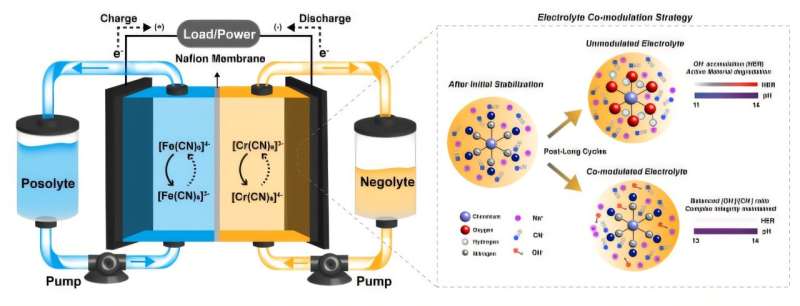
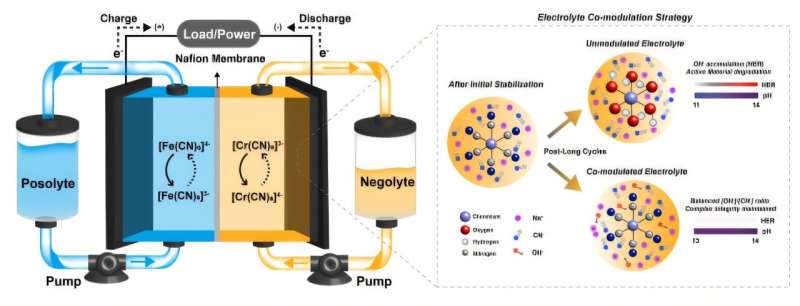
Researchers affiliated with UNIST have managed to prolong the lifespan of iron-chromium redox flow batteries (Fe-Cr RFBs), large-capacity and explosion-proof energy storage systems (ESS). This advancement enhances the safety and reliability of storing renewable energy sources, such as wind and solar, which often produce electricity intermittently, enabling secure storage and on-demand retrieval.
The findings are published in Angewandte Chemie International Edition.
Professor Hyun-Wook Lee from the School of Energy Chemical Engineering at UNIST, in collaboration with Professor Dong-Hwa Seo of KAIST and Professor Guihua Yu from the University of Texas at Austin, identified the causes of performance degradation in iron-chromium flow batteries. They also developed an optimized electrolyte formulation that maintains capacity through repeated charge and discharge cycles.
Unlike conventional batteries, flow batteries store energy in liquid electrolytes that act as liquid electrodes. The electrolytes are circulated via pumps during charging and discharging.
Using water instead of volatile chemicals makes them inherently safer with no explosion risk. Additionally, their capacity can be easily adjusted by controlling the electrolyte volume, making them suitable for large-scale energy storage from variable renewable sources.
The team discovered that the primary cause of capacity decline is a ligand exchange process involving hexacyanochromate ([Cr(CN)6]4-/3-). Although adding hexacyanochromate improves output and charging speed, cycling induces a side reaction where cyanide (CN–) ions surrounding chromium ions are replaced by hydroxide (OH–) ions. This exchange destabilizes the electrolyte structure, leading to rapid capacity loss.
To address this, the researchers optimized the ratio of cyanide to hydroxide ions within the electrolyte, effectively suppressing the unwanted reaction. The new electrolyte formulation reliably maintained stable capacity and efficiency over more than 250 cycles.
Professor Lee emphasized, “This work demonstrates the potential to develop high-performance, long-lasting flow batteries using cost-effective iron-chromium electrolytes. Such technology is especially promising for countries with abundant renewable resources and large land areas, like China and European nations, seeking scalable energy storage solutions.”
While vanadium flow batteries are currently closer to commercial deployment, their high costs and limited regional resource availability present challenges. This breakthrough offers an alternative approach towards more affordable and scalable large-capacity energy storage.
More information:
Ji‐Eun Jang et al, Elucidating Ligand Exchange Dynamics of Hexacyanochromate‐Based Redox Mediators in Aqueous Iron‐Chromium Redox Flow Batteries, Angewandte Chemie International Edition (2025). DOI: 10.1002/anie.202507119
Citation:
Extending the lifespan of large-scale safe energy storage with iron-chromium flow batteries (2025, August 21)
retrieved 22 August 2025
from https://techxplore.com/news/2025-08-lifespan-large-scale-safe-energy.html
This document is subject to copyright. Apart from any fair dealing for the purpose of private study or research, no
part may be reproduced without the written permission. The content is provided for information purposes only.