
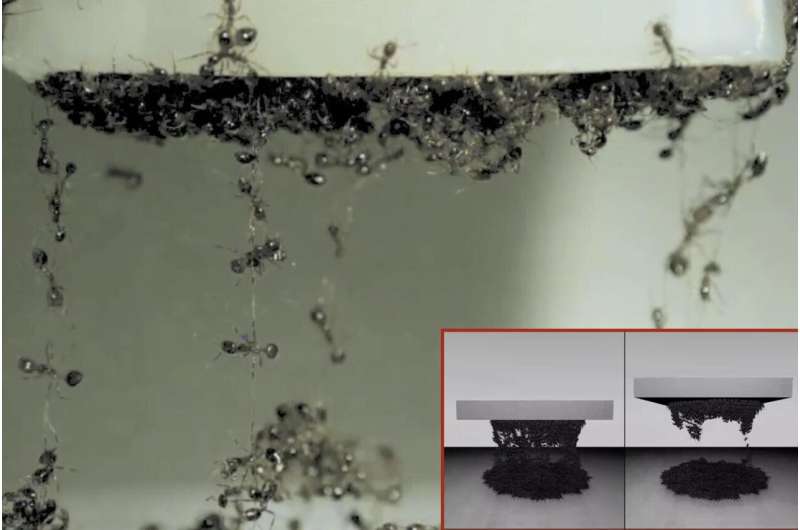
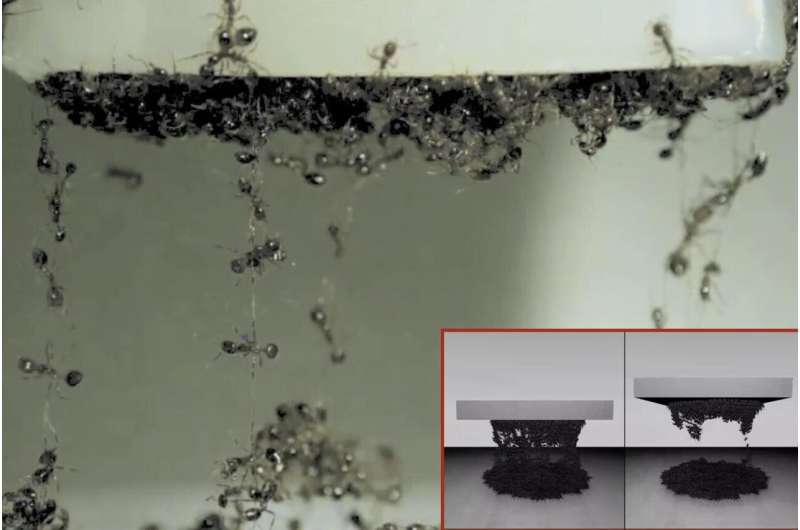
Think twice about eliminating those pesky ants at your next family picnic. Their behavior may hold the key to reinventing how engineering materials, traffic control and multi-agent robots are made and utilized, thanks to research conducted by recent graduate Matthew Loges and Assistant Professor Tomer Weiss from NJIT’s Ying Wu College of Computing.
The two earned a best presentation award for their research paper titled “Simulating Ant Swarm Aggregations Dynamics” at the ACM SIGGRAPH Symposium for Computer Animation (SCA), and a qualifying poster nomination for the undergraduate research competition at the 2025 ACM SIGGRAPH (Special Interest Group on Computer Graphics and Interactive Techniques) conference.
Their study began with the observation that ant swarms behave in a manner similar to both fluid and elastic materials. The duo began work in the summer of 2024. Loges became interested in research after he took an elective class with Weiss, IT 360 Computer Graphics for Visual Effects, at the Department of Informatics. This was his first project and research paper.
According to Weiss, there is a lot of motivation in replicating ant swarm behavior. Ants behave as a sort of active matter that morphs and adjusts in shape as needed. If you try to cut a blob of ants, it will just reform to its original shape. This can lead to new discoveries in engineering materials such as smart, self-healing concrete, or innovations in navigation of multi-agent robots and traffic control.
Weiss’s broader research spans computer graphics, physics-based simulations and AI-driven modeling of natural phenomena. He notes that understanding how biological systems like ant swarms exhibit both fluid and elastic properties offers a foundation for creating new algorithms that bridge biology and computer science. His group’s aim is not only to simulate realistic behaviors but also to translate those findings into practical innovations in material science, robotics and large-scale systems.
The research team then went about successfully designing a computational simulation algorithm that could incorporate both the fluid and elastic real-world behavior of ants observed in lab experiments.
More information:
Matthew Loges et al, Simulating the Mechanics of Ant Swarm Aggregations, Proceedings of the Special Interest Group on Computer Graphics and Interactive Techniques Conference Posters (2025). DOI: 10.1145/3721250.3742999
Citation:
Ant swarm simulation unlocks possibilities in materials engineering, robot navigation and traffic control (2025, September 15)
retrieved 16 September 2025
from https://techxplore.com/news/2025-09-ant-swarm-simulation-possibilities-materials.html
This document is subject to copyright. Apart from any fair dealing for the purpose of private study or research, no
part may be reproduced without the written permission. The content is provided for information purposes only.