
Biological systems have inspired the development of next-generation soft robotic systems with diverse motions and functions. Such versatility in soft robots—in terms of rapid and efficient crawling—can be achieved via asymmetric bending through bilayer-type actuators that combine responsive liquid crystal elastomers (LCEs) with flexible substrates. This, in turn, requires temperature-responsive LCEs with accurate temperature regulation via elaborate Joule heating configurations.
However, it is a complicated task owing to the difficulty in generating asymmetric motions using isotropic thermal distributions, necessitating simple temperature gradient patterning and bilayer fabrication technologies.
Addressing these challenges, a team of researchers from the Department of Chemical Engineering at Chung-Ang University, led by Professor Suk Tai Chang and Assistant Professor Changyeon Lee, have proposed a facile electroless plating method for patterning asymmetric temperature gradients on paper substrates, ultimately resulting in the development of innovative caterpillar-inspired soft robots. Their findings were made available online and published in the journal Advanced Functional Materials on 30 July 2025.
Prof. Chang sheds light on the motivation behind their research. “Our motivation for this work comes from the fascinating world of nature, specifically the crawling motion of caterpillars. We were intrigued by how such a simple organism could achieve highly efficient locomotion through sequential bending and stretching. I wanted to replicate this elegant mechanism in a soft robotic system, but without the complexity of traditional methods that often require intricate heating configurations.”
With this vision in mind, the researchers chose cellulose-based paper—a common and eco-friendly material—as the substrate for the soft robots. Furthermore, instead of complex circuit designs, they turned to printing-based electrode patterning technology to dramatically simplify the fabrication process.
“Cellulose-based paper substrates provide distinct advantages due to their porous structure, which enables facile electrode deposition via solution-based processes and offers high mechanical deformability,” remarks Prof. Lee.
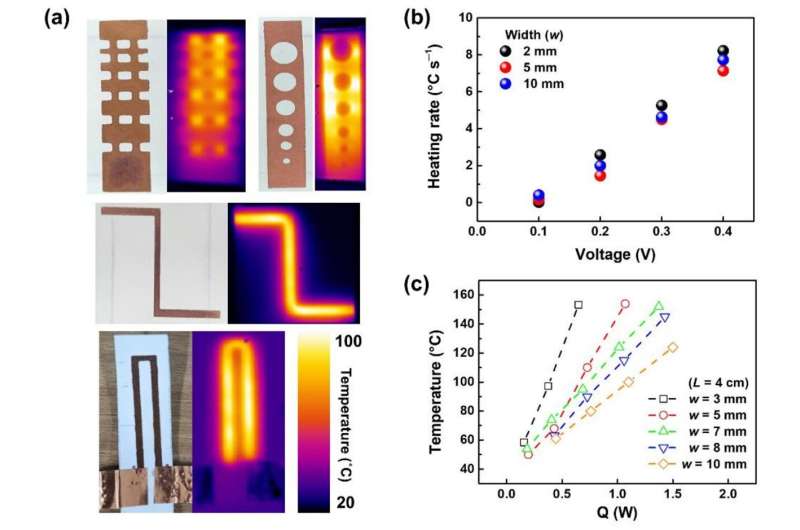
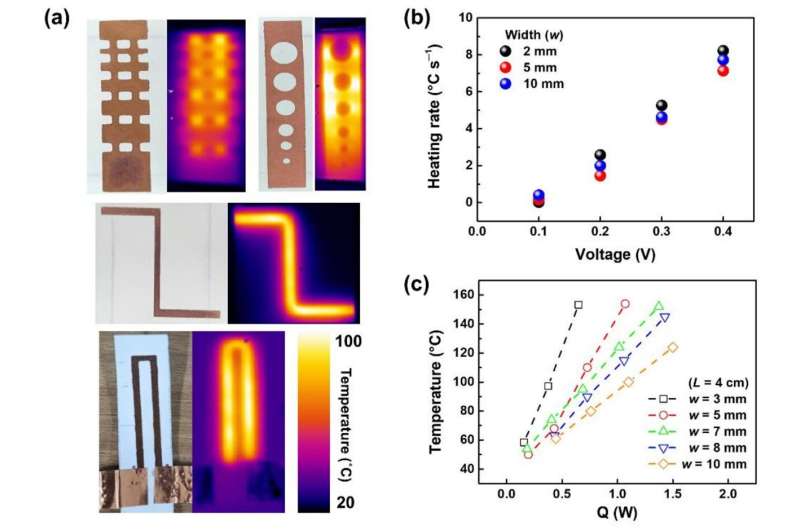
In this study, the team deposited Cu electrodes asymmetrically on paper substrates by changing electrode widths. This variation caused electrical resistance gradients, producing significant temperature gradients across the substrate. This process finally resulted in energy-efficient soft robots capable of directional crawling at a low actuation voltage value via paper substrate integration with LCEs in a bilayer architecture.
“In this way, we successfully achieved asymmetric bending motion, which is a difficult feat for conventional soft robots. By precisely controlling the temperature gradient on the paper-based electrode, we were able to induce differential bending, which mimics the natural crawling motion of a caterpillar. This novel mechanism enables directional and controlled movement for soft robots,” points out Prof. Chang.
The lightweight and thin crawling robot presented in this work could be used for environmental monitoring or performing special tasks in environments that are difficult for humans to reach, whether due to physical constraints or safety concerns.
Overall, the simplicity and cost-effectiveness of the electrode patterning process, in combination with the abundance and eco-friendly nature of paper-based actuators, is a promising approach for the scalable and sustainable fabrication of real-life soft robots, paving the way for the widespread integration of soft robots into our daily lives.
More information:
In Hyeok Oh et al, Crawling Soft Robotic Locomotion via Asymmetric Temperature Distribution on Paper‐Based Electrodes, Advanced Functional Materials (2025). DOI: 10.1002/adfm.202512328
Provided by
Chung Ang University
Citation:
Paper electrode-based soft robot achieves crawling motion (2025, August 21)
retrieved 22 August 2025
from https://techxplore.com/news/2025-08-paper-electrode-based-soft-robot.html
This document is subject to copyright. Apart from any fair dealing for the purpose of private study or research, no
part may be reproduced without the written permission. The content is provided for information purposes only.