
Researchers in China claim to have achieved a significant breakthrough in lithium battery technology, doubling the energy density (the amount of energy a battery can store relative to its size and weight) of Tesla’s most advanced batteries.
Lithium batteries are a crucial component for electric vehicles due to their high energy density, which allows them to store a large amount of energy in a relatively compact, lightweight package. This is essential for achieving a long driving range on a single charge.
Currently, Tesla’s best batteries have an energy density of about 300 watt-hours per kilogram, while the battery developed by researchers at Tianjin University has an energy density of more than 600 watt-hours per kilogram. The greater the energy density, the smaller and lighter a battery can be, which can ultimately improve a vehicle’s range and performance.
Overcoming the limitations of lithium batteries
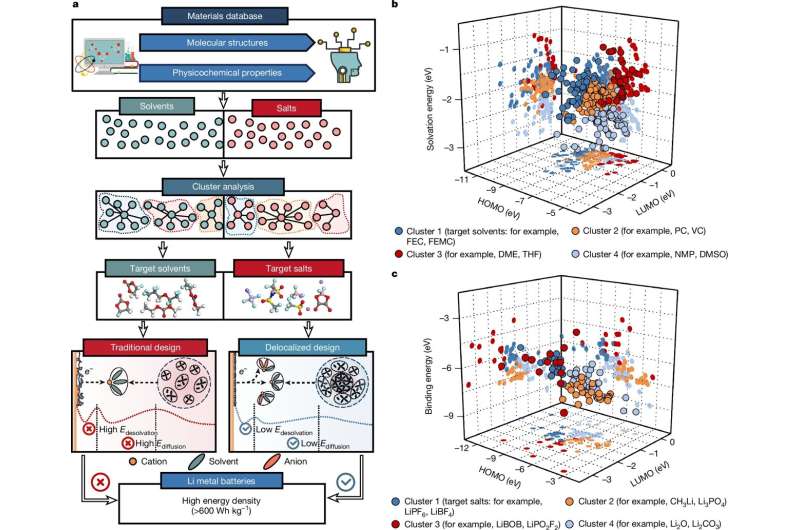
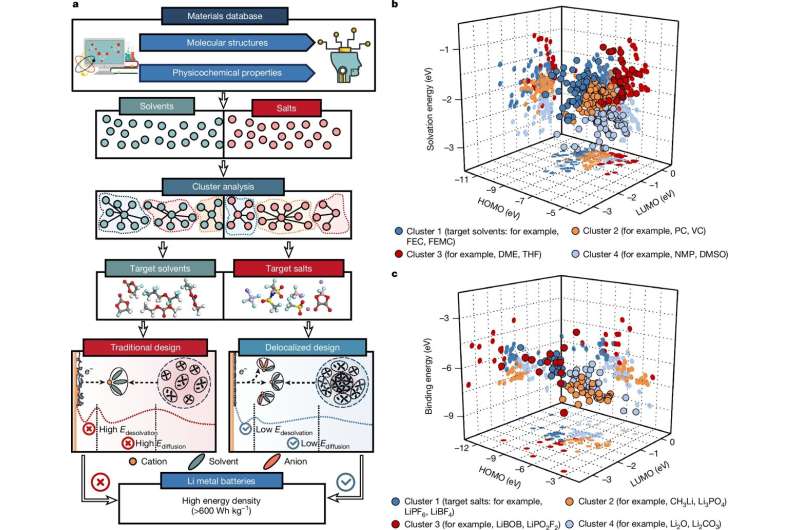
One of the problems with the current generation of lithium batteries is the liquid inside them, called the electrolyte, through which lithium ions travel. The issue is that the electrolyte can become “clogged” as each lithium ion is surrounded by others, creating a rigid, organized structure that limits the battery’s efficiency, stability and performance.
Presenting their findings in the journal Nature, the Chinese researchers describe a novel solution. They created a new electrolyte with a more disorganized structure that allows the ions to move more freely.
“The delocalized electrolyte design overcomes the intrinsic constraints of conventional electrolytes by inducing a highly disordered solvation microenvironment, effectively reducing dynamic barriers, stabilizing interphases and offering substantial potential for transformative advances in battery performance,” wrote the researchers.
When they tested their new battery, it achieved impressive energy densities of 604.2 watt-hours per kilogram. It also remained stable for more than 100 charging and discharging cycles. Additionally, the electrolyte didn’t ignite under open flame and worked at -60°C without freezing.
Currently, the battery is proof-of-concept and is not yet ready for mass production. While it has shown promising results in controlled laboratory conditions, its performance and safety will need to be extensively tested in the real world.
If the new battery can eventually be scaled up, the potential is enormous. Lighter, longer-lasting batteries in electric vehicles would significantly increase their range and reduce the amount of time spent charging. There are also applications beyond electric cars, such as improving energy storage for renewable power grids and creating safer, higher-capacity batteries for a range of consumer electronics.
Written for you by our author Paul Arnold,
edited by Lisa Lock, and fact-checked and reviewed by Robert Egan—this article is the result of careful human work. We rely on readers like you to keep independent science journalism alive.
If this reporting matters to you,
please consider a donation (especially monthly).
You’ll get an ad-free account as a thank-you.
More information:
He Huang et al, Delocalized electrolyte design enables 600 Wh kg−1 lithium metal pouch cells, Nature (2025). DOI: 10.1038/s41586-025-09382-4
© 2025 Science X Network
Citation:
Battery breakthrough could transform electric car performance and range (2025, August 18)
retrieved 19 August 2025
from https://techxplore.com/news/2025-08-battery-breakthrough-electric-car-range.html
This document is subject to copyright. Apart from any fair dealing for the purpose of private study or research, no
part may be reproduced without the written permission. The content is provided for information purposes only.