
When we are out in cold weather, we wear warm clothes to stay comfortable. But there is a snag. Regular warm clothing can’t adjust to changes in our body temperature. If we start to sweat, we get too hot and sticky, which makes us want to remove layers. This defeats the purpose of wearing them, since we still need to stay warm.
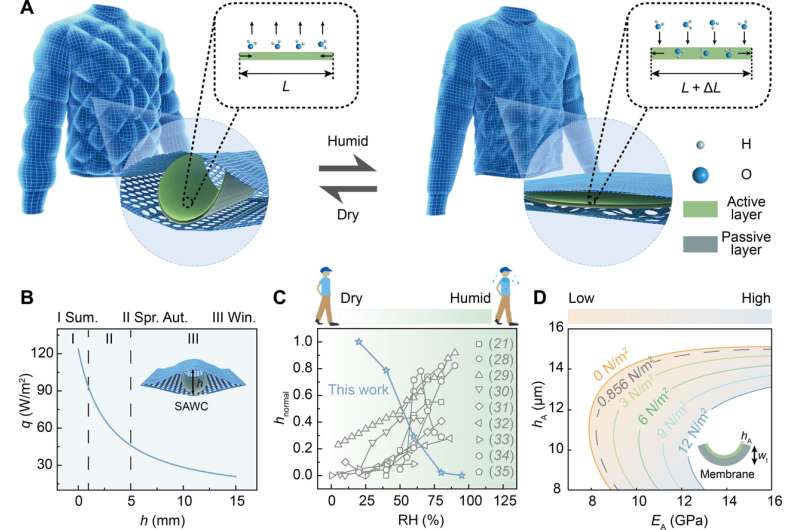
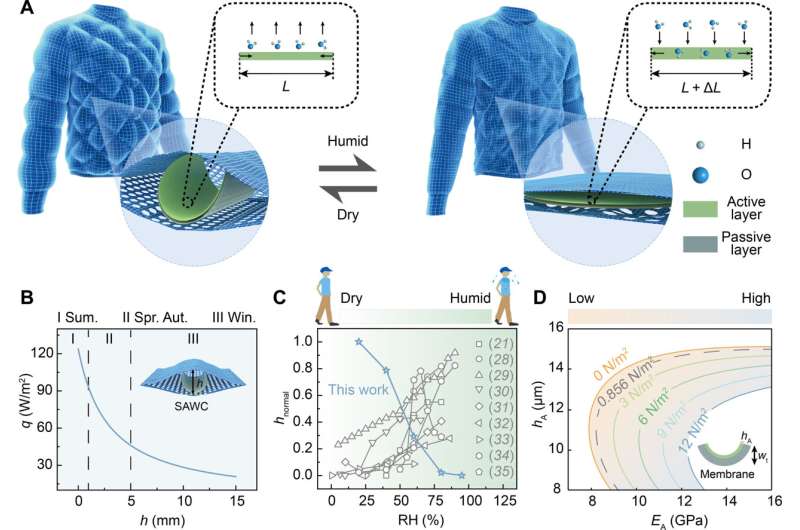
But what if our clothes could adapt? That’s the question Xiuqiang Li at Nanjing University of Aeronautics and Astronautics in China and his colleagues set out to answer. They have developed a jacket with a filling made from a bacterial cellulose membrane that responds to human sweating.
The innovative membrane automatically adjusts its thickness based on humidity. It’s 13 millimeters thick in cool, dry conditions and shrinks to just 2 millimeters when humidity levels are high, such as when you sweat. This allows the jacket to be thick when you need to stay warm and then get thinner when you want to cool down a little.
To prove their innovation works, the scientists first used a system that mimics human skin to test its thermal regulation in a controlled environment. Then they took it out into the real world, integrating the material into commercial down jackets and monitoring their performance on people who were walking or cycling.
The results were published in the journal Science Advances, where the researchers noted their sweat-activated clothing is better at controlling body temperature than traditional jackets. “Our sweat-sensitive adaptive warm clothing can expand the thermal regulation capability by up to 82.8% compared to traditional textiles, and extend the no-thermal stress zone by an average of 7.5 hours across 20 cities.”
Applications
This new technology has a wide range of potential applications and benefits. Fillings made of the bacterial cellulose membrane could be integrated into various types of clothing for different professions and climates. Outdoor workers such as sanitation staff, couriers and police could stay comfortable for longer periods.
Sweat-sensitive clothing could also help reduce the risk of heat-related health issues that can occur when wearing heavy gear in cold weather, such as dehydration, fatigue and dizziness.
However, more work needs to be done before this clothing is available on the high street. Future research will need to look at how the material performs in extreme weather conditions, its durability over the longer term and its effectiveness in different types of clothing.
Written for you by our author Paul Arnold,
edited by Lisa Lock, and fact-checked and reviewed by Robert Egan—this article is the result of careful human work. We rely on readers like you to keep independent science journalism alive.
If this reporting matters to you,
please consider a donation (especially monthly).
You’ll get an ad-free account as a thank-you.
More information:
Xiaofeng Jiang et al, Sweat-sensitive adaptive warm clothing, Science Advances (2025). DOI: 10.1126/sciadv.adu3472
© 2025 Science X Network
Citation:
Sweat-sensitive jacket adjusts its thickness to keep you comfortable when it’s cold (2025, August 14)
retrieved 15 August 2025
from https://techxplore.com/news/2025-08-sensitive-jacket-adjusts-thickness-comfortable.html
This document is subject to copyright. Apart from any fair dealing for the purpose of private study or research, no
part may be reproduced without the written permission. The content is provided for information purposes only.